Explore climates.im

Seasons

Seasons

A 23.4-degree tilt, two other official NASA figures kept beside it, and a winter that arrives when Earth is closest to the Sun.
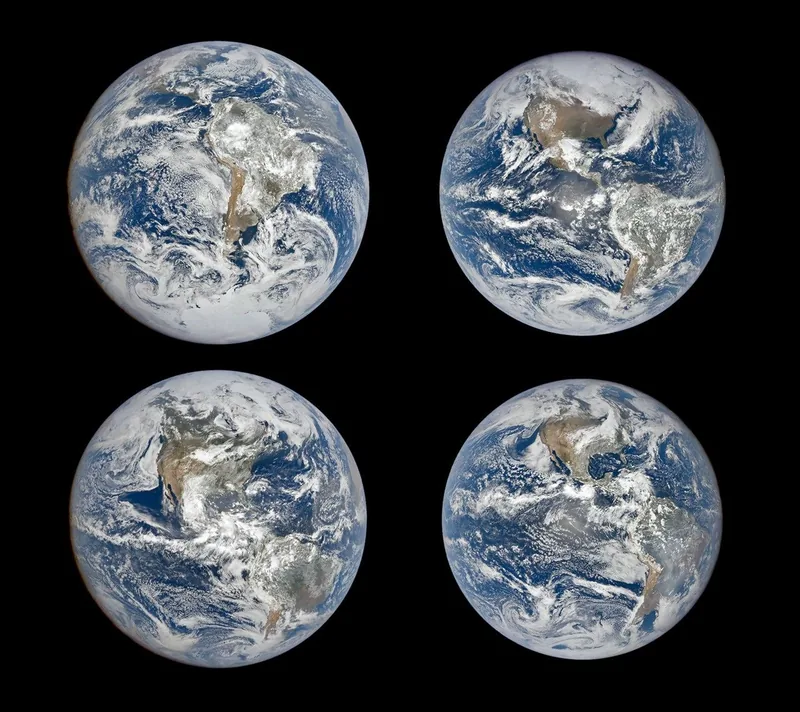
Four DSCOVR EPIC views of Earth on the December and June solstices and the March and September equinoxes, showing how the continents appear to shift with the tilt of the axis.
An Epic View of the Seasons, a NASA Earth Observatory still by Michala Garrison from EPIC on NOAA’s DSCOVR spacecraft, taken 22 September 2024. The official description: images show Earth on the December and June solstices and the March and September equinoxes, illustrating how the tilt of Earth’s axis shifts the continents’ apparent positions through the year. Satellite image: NASA Earth Observatory / Michala Garrison, EPIC on DSCOVR · Public domain · NASA Earth Observatory / Michala Garrison / Wikimedia Commons

A tilt, not a closer Sun

NASA’s Facts About Earth page is plain: “Earth's axis of rotation is tilted 23.4 degrees with respect to the plane of Earth's orbit around the Sun. This tilt causes our yearly cycle of seasons.” [source] When the Northern Hemisphere is tilted toward the Sun, that page says, it is summer there and winter in the Southern Hemisphere; about six months later the tilt is reversed. In spring and fall, both hemispheres receive roughly equal amounts of heat.
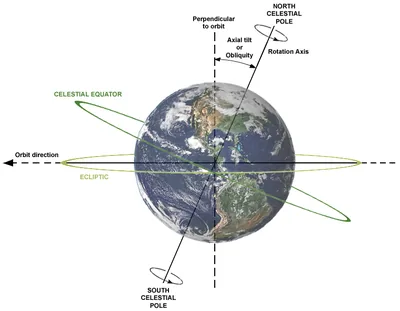
A diagram of Earth’s axial tilt, or obliquity, showing the rotation axis, the plane of the orbit, the celestial equator and the ecliptic.
A 22 December 2007 diagram by Dna-webmaster, used under CC BY 3.0, with an Earth image from NASA. The file description: relations between axial tilt (or obliquity), rotation axis, plane of orbit, celestial equator and ecliptic. Earth is shown as viewed from the Sun; the orbit direction is counter-clockwise (to the left). Official tilt figures on this site come from the NASA and Met Office pages, not from this diagram’s labels. Diagram: Dna-webmaster (Earth image from NASA) · CC BY 3.0 · Dna-webmaster / NASA Earth image / Wikimedia Commons

Other official NASA pages do not use the same number of decimal places. The Earth Fact Sheet, last updated 15 November 2024, gives the obliquity to orbit as 23.44°. [source] A NASA resource on seeing equinoxes and solstices from space says the axis is tilted 23.5 degrees relative to the Sun and the ecliptic plane. [source] Those three official figures sit side by side on the why desk, and are not averaged.
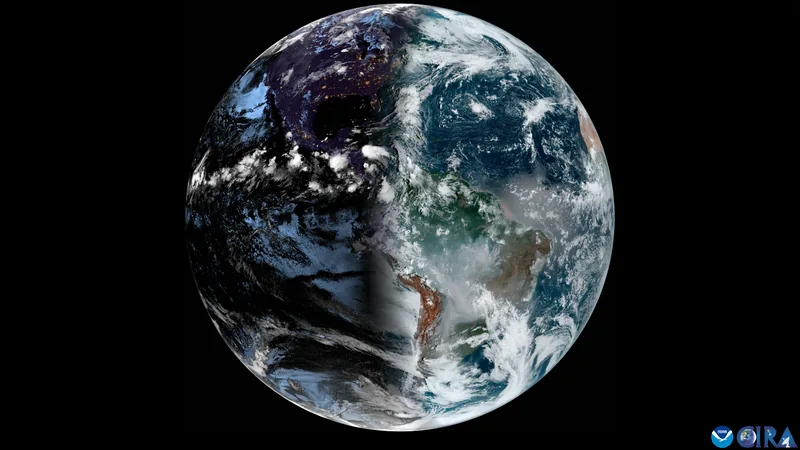
A GOES view of Earth on the 22 September 2024 equinox, with the terminator running across the globe.
“Watch the Terminator Sway From Season to Season,” GOES imagery from CSU/CIRA and NOAA, taken on 22 September 2024. The file description, in its own wording, is: “On the fall 2024 equinox, we watch the terminator sway from to season.” The incomplete sentence is left as the file wrote it. Satellite image: CSU/CIRA and NOAA, GOES imagery · Public domain · CSU/CIRA & NOAA / Wikimedia Commons

NASA Space Place adds the fact that still catches people out: the Northern Hemisphere has winter when Earth is closest to the Sun, and summer when farthest. [source] Distance is not the cause. The Met Office, for its part, keeps two calendars — meteorological months and astronomical solstices — and a precise word, equilux, for the day when day and night really are equal. [source]

Keep the lights on

Enjoyed a desk of official tilts, unblended figures, and a few seasonal stills?

No pop-ups. No intrusive advertising. Just interesting stuff. A little support helps the next climates.im site get built.