Facts
Official figures, in their original wording
Where two official pages disagree, both rows stay.
Official figures, kept in their original wording. Where two pages disagree, both rows stay.
| What | Official wording | Source |
|---|---|---|
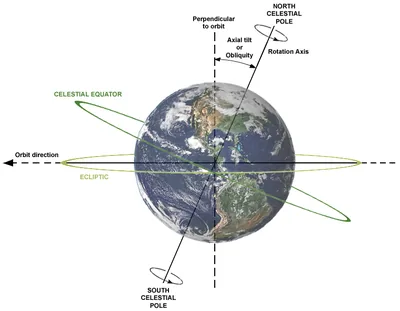
| Cause of the seasons | Earth's axis of rotation is tilted 23.4 degrees with respect to the plane of Earth's orbit around the Sun. This tilt causes our yearly cycle of seasons. | NASA Facts About Earth [source] |
| Obliquity, Fact Sheet | Obliquity to orbit 23.44°; inclination of equator 23.44° | NASA Earth Fact Sheet, 15 November 2024 [source] |
| Tilt, Earth Observatory resource | The axis of the Earth is tilted 23.5 degrees relative to the Sun and the ecliptic plane | NASA, Seeing Equinoxes and Solstices from Space [source] |
| Orbit, kilometres | Semimajor axis 149.598 million km; perihelion 147.095 million km; aphelion 152.100 million km; sidereal 365.256 days; tropical 365.242 days | NASA Earth Fact Sheet [source] |
| Orbit, miles | Perihelion 91,400,000 miles, January; aphelion 94,500,000 miles, July; difference “over 3 million miles” | NASA Space Place [source] |
| Winter at perihelion | The Northern Hemisphere has winter when Earth is closest to the Sun and summer when farthest. Distance is not the cause of the seasons. | NASA Space Place [source] |
| Equinox dates (Met Office) | Around 20 March (spring) and 22 September (autumn) in the Northern Hemisphere; “equal night”; day and night nearly equal | Met Office [source] |
| Equilux | The day when day and night are exactly equal: a few days before the spring equinox and a few days after the autumn equinox, from the Sun’s apparent size and atmospheric refraction | Met Office [source] |
| Solstices (Met Office) | Around 21 June and 21 December. Arctic Circle 24 hours of daylight at the June solstice; Antarctic Circle in complete darkness; reversed in December | Met Office [source] |
| Terminator (NASA resource) | On March 20 and September 20, the terminator is a straight north-south line | NASA, Seeing Equinoxes and Solstices from Space [source] |
| Meteorological seasons | Spring 1 March–31 May; summer 1 June–31 August; autumn 1 September–30 November; winter 1 December–last day of February | Met Office season pages [source] [source] [source] [source] |
| UK averages, 1991–2020 | Summer 14.59°C; winter 4.09°C | Met Office summer and winter pages [source] [source] |
| Shortest day (UK wording) | Daylight lasting just 7 hours and 50 minutes — almost nine hours less than the longest day in summer. Earliest sunset a few days before the solstice. | Met Office winter [source] |
Enjoyed a desk of official tilts, unblended figures, and a few seasonal stills?
No pop-ups. No intrusive advertising. Just interesting stuff. A little support helps the next climates.im site get built.