Explore climates.im

Solstice

Equinoxes, solstices, and the equilux

Equal night is nearly equal. Exactly equal has its own official name, a few days to either side.
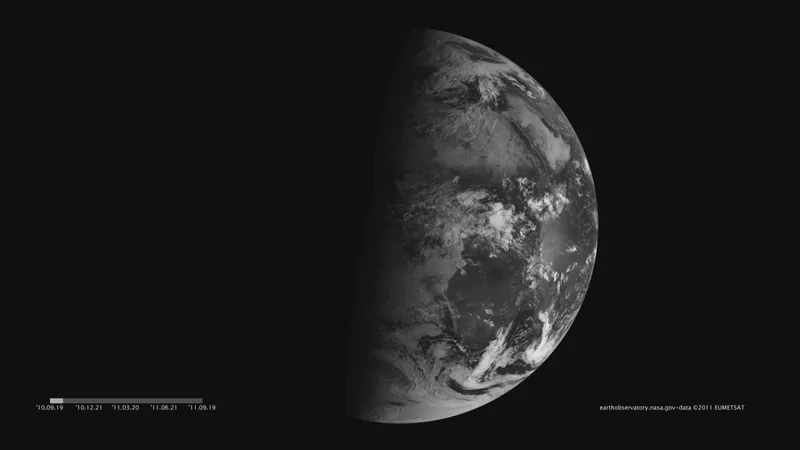
A Meteosat view of Earth with a straight north-south terminator, the line between day and night.
A still from “Seeing Equinoxes and Solstices from Space,” images acquired 21 December 2010 to 20 September 2011. The NASA resource, crediting NASA images and animation by Robert Simmon using data ©2010 EUMETSAT, says that on 20 March and 20 September the terminator is a straight north-south line, and that equinox means “equal night” in Latin. The same resource gives the axial tilt as 23.5 degrees; that figure is kept unblended with 23.4 and 23.44 on the why desk. Satellite image: NASA images and animation by Robert Simmon, using data ©2010 EUMETSAT (NASA GSFC file) · Public domain · NASA GSFC / Robert Simmon / EUMETSAT data / Wikimedia Commons

The Met Office page on equinoxes and solstices puts the Northern Hemisphere equinoxes at around 20 March (spring) and 22 September (autumn). Equinox means “equal night” in Latin. Day and night are nearly equal. [source] Solstices are around 21 June and 21 December. At the June solstice the Arctic Circle has 24 hours of daylight and the Antarctic Circle is in complete darkness; that reverses at the December solstice. [source]

Equilux, a few days to either side

Exactly equal day and night is a slightly different day. The Met Office calls it the equilux: a few days before the spring equinox and a few days after the autumn equinox, because of the Sun’s apparent size and atmospheric refraction. [source]
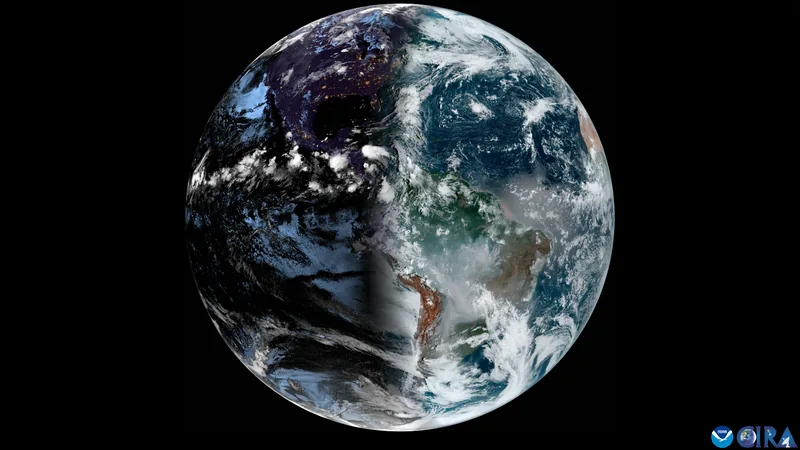
A GOES view of Earth on the 22 September 2024 equinox, with the terminator running across the globe.
“Watch the Terminator Sway From Season to Season,” GOES imagery from CSU/CIRA and NOAA, taken on 22 September 2024. The file description, in its own wording, is: “On the fall 2024 equinox, we watch the terminator sway from to season.” The incomplete sentence is left as the file wrote it. Satellite image: CSU/CIRA and NOAA, GOES imagery · Public domain · CSU/CIRA & NOAA / Wikimedia Commons

A straight terminator, on a NASA date

A NASA resource, “Seeing Equinoxes and Solstices from Space,” says: “The axis of the Earth is tilted 23.5 degrees relative to the Sun and the ecliptic plane.” On 20 March and 20 September, it says, the terminator is a straight north-south line. [source] Those calendar dates are that page’s wording. They are not used here as a silent correction of the Met Office’s “around 20 March” and “around 22 September.”

The midnight sun over Longyearbyen, Svalbard, at 1:06 a.m. on 3 July 2026.
Midnight sun over Longyearbyen, Svalbard, 3 July 2026, at 1:06 a.m. (CEST), photographed by Kawon Kez Sel and released under CC0. The Met Office notes that the Arctic Circle has 24 hours of daylight at the June solstice; this July still is a later, credited view of that northern summer light, not a repeat of the Antarctic midnight-sun photographs on polar.climates.im. Photo: Kawon Kez Sel · CC0 · Kawon Kez Sel / Wikimedia Commons

The midnight-sun still above is Longyearbyen, Svalbard, at 1:06 a.m. on 3 July 2026 — after the June solstice, still in northern summer light. Polar daylight and polar night, as climates of their own, live on polar.climates.im.

Keep the lights on

Enjoyed a desk of official tilts, unblended figures, and a few seasonal stills?

No pop-ups. No intrusive advertising. Just interesting stuff. A little support helps the next climates.im site get built.