Beyond Earth
Seasons on other planets
Earth is not the only world with seasons. Any planet with a tilted axis gets them, and the length of its year decides how long they last. Some of the results are very strange indeed.
The recipe: a tilt and a year
NASA’s short answer for Earth is that “Earth’s tilted axis causes the seasons.” When the North Pole tilts towards the Sun, it is summer in the Northern Hemisphere, and when the South Pole tilts towards the Sun, it is winter in the north. [NASA Space Place] Change the tilt and you change how strong the seasons are. Change the length of the year and you change how long each season lasts.
NASA keeps both numbers for every planet in one place, its Planetary Fact Sheet. There the tilt is called “obliquity to orbit”, and Earth’s is 23.4 degrees. Earth’s orbital period is 365.2 days. [NASA Planetary Fact Sheet] Every other world on the sheet has its own pair, and you can try them all in the Planet Season Explorer.
Here is the list, straight from the sheet: Mercury 0.034 degrees, Venus 177.4, Earth 23.4, Mars 25.2, Jupiter 3.1, Saturn 26.7, Uranus 97.8, Neptune 28.3 and Pluto 119.5. [NASA Planetary Fact Sheet] Three of those are above 90 degrees, which means the planet is tipped past its side and spins the “wrong” way round compared with most planets.
Uranus: the planet on its side
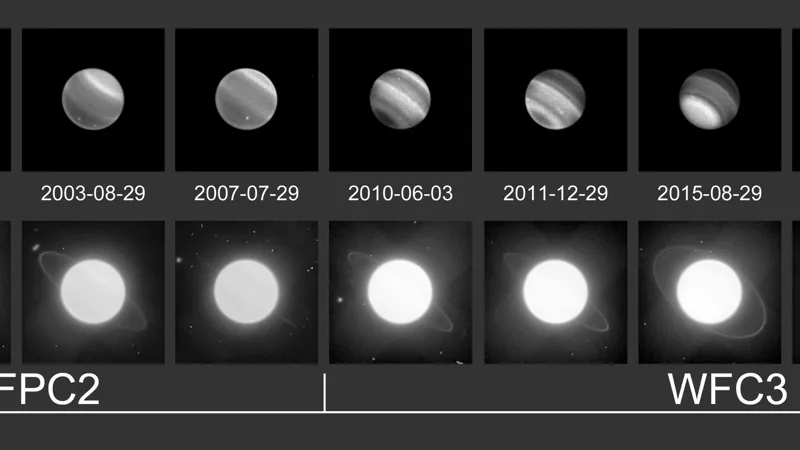
Uranus is the champion. NASA says it is the only planet whose equator is nearly at a right angle to its orbit, with a tilt of 97.77 degrees, and that it appears to spin sideways, “orbiting the Sun like a rolling ball.” [NASA] The fact sheet rounds the same tilt to 97.8 degrees. [NASA Planetary Fact Sheet]
That tilt, NASA says, “causes Uranus to have the most extreme seasons in the solar system.” For nearly a quarter of each Uranian year the Sun shines directly over each pole, plunging the other half of the planet into a 21-year-long, dark winter. [NASA] A Uranian year lasts about 84 Earth years, or 30,687 Earth days. [NASA] Put those together and a child born near a pole of Uranus just as its winter began would be about 21 before seeing the Sun there.
Even its magnetism is tipped over. NASA says Uranus’s magnetic axis is tilted nearly 60 degrees from its axis of rotation, and is offset from the centre of the planet by one third of its radius. Its sideways spin twists the magnetic field lines into a long corkscrew shape. [NASA]
The planet was discovered in 1781 by William Herschel, who at first thought it was either a comet or a star. He tried, without success, to name it Georgium Sidus after King George III. [NASA]
Neptune: four seasons, 165 years
Neptune’s tilt is ordinary. NASA gives it as 28 degrees, “similar to the axial tilts of Mars and Earth”, so Neptune experiences seasons just like we do. The difference is the calendar: “since its year is so long, each of the four seasons lasts for over 40 years.” [NASA]
A Neptunian year is about 165 Earth years, or 60,190 Earth days, on NASA’s Neptune page. [NASA] NASA adds that in 2011 Neptune completed its first 165-year orbit since its discovery in 1846. [NASA] In other words, nobody had ever watched a whole Neptunian year until 2011.
Two NASA numbers: NASA’s Neptune page gives a year of 60,190 Earth days, while the Planetary Fact Sheet gives an orbital period of 59,800 days. [NASA] [NASA Planetary Fact Sheet] The same happens for Uranus (30,687 days against 30,589) and Saturn (10,756 against 10,747). [NASA] [NASA] [NASA Planetary Fact Sheet] We quote each one as its own page gives it; the explorer uses the fact sheet throughout. See the field notes.
Saturn: seasons like ours, but seven times longer
Saturn is tilted by 26.73 degrees, which NASA calls “similar to Earth’s 23.5-degree tilt.” That means, NASA says, that “like Earth, Saturn experiences seasons.” [NASA] Its year is about 29.4 Earth years, or 10,756 Earth days, and a day there takes only 10.7 hours. [NASA] Divide its year by four and an average Saturnian season is a little over seven Earth years.
You may notice that NASA’s Saturn page gives Earth’s tilt as 23.5 degrees while the fact sheet and the Mars page give 23.4. [NASA] [NASA Planetary Fact Sheet] [NASA] Both are roundings of the same tilt; this site’s discoveries page has more on Earth’s three tilts.
Mars: seasons of different lengths

Mars has a tilt very close to ours: 25 degrees on NASA’s Mars page, or 25.2 on the fact sheet. [NASA] [NASA Planetary Fact Sheet] So it has distinct seasons. But a Martian year lasts 669.6 sols, which is the same as 687 Earth days, so the seasons last longer than ours. [NASA] A sol is a Martian day, short for “solar day.” [NASA]
The odd thing is that the Martian seasons are not equal. NASA explains that while Earth’s seasons are evenly spread, on Mars they vary in length because of its “elliptical, egg-shaped orbit around the Sun.” Northern spring is the longest, at 194 sols. Northern autumn is the shortest. Northern winter is 154 sols and northern summer 178 sols. [NASA]
The oval orbit changes the heat as well as the timing. NASA says Mars is farther from the Sun during northern summer, “meaning that southern summer is warmer than northern summer.” [NASA] Mars also has a dust season. Dust storms happen all year, but there are often more of them in certain seasons, and they can make the solar panels on surface missions less efficient. [NASA]
Jupiter and Mercury: hardly any tilt
At the other extreme are the worlds that stand nearly upright. Jupiter’s equator is tilted by just 3 degrees, which NASA says means that it “spins nearly upright and does not have seasons as extreme as other planets do.” [NASA] Mercury’s tilt on the fact sheet is a tiny 0.034 degrees. [NASA Planetary Fact Sheet]
Mercury makes up for it with its orbit. Its distance from the Sun ranges from 46.0 million km at perihelion to 69.8 million km at aphelion, and its orbital eccentricity, 0.206, is the largest of the eight planets on the sheet. [NASA Planetary Fact Sheet] Earth’s is 0.017. [NASA Planetary Fact Sheet] On Earth the distance changes are small, which is why being closest to the Sun in January does not stop it being winter in Britain; see closest in January, farthest in July.
Venus: upside down
Venus has a tilt of 177.4 degrees on the fact sheet, which is almost exactly upside down. [NASA Planetary Fact Sheet] NASA puts it more simply: “Venus spins slowly in the opposite direction from most planets.” [NASA] It spins so slowly that its day, 243 Earth days, is longer than its year of 225 Earth days. [NASA]
And the Sun has “seasons” too
NASA says the Sun also has changing seasons, but they are not caused by tilt. Most of its changes come from the solar cycle, which runs roughly 11 years from a solar maximum, with more sunspots and activity, to a solar minimum, with less. [NASA] Spacecraft such as SDO and SOHO track these solar “seasons.” [NASA]
Try it: the Planet Season Explorer draws each world’s tilt to scale and works out how old you would be there.
Enjoyed a desk of official tilts, unblended figures, and a few seasonal stills?
No pop-ups. No intrusive advertising. Just interesting stuff. A little support helps the next climates.im site get built.