Signature tool
The Planet Season Explorer
A planet’s seasons come from two numbers: how far it is tipped over, and how long it takes to go round the Sun. Choose a world and see both.
Our signature tool
The Planet Season Explorer
Every planet has a tilt and a year. Together they decide how strong its seasons are and how long each one lasts. Pick a world to see its tilt drawn to scale, how long its year and its average season last, and how old you would be there. The numbers come from NASA’s Planetary Fact Sheet. [NASA Planetary Fact Sheet]
Tilt:
One year:
Average season:
In the diagram the grey line is the plane of the orbit, the dashed line is “straight up” and the dark line is the world’s spin axis, with a dot at its north pole. An average season is a quarter of the year. Real seasons can be uneven when an orbit is oval, as on Mars. [NASA]
The numbers behind the explorer
Here are all nine worlds from the fact sheet, for anyone reading without the explorer. Pluto is a dwarf planet, but NASA keeps it in the same table. [NASA Planetary Fact Sheet]
| Body | Tilt | Year, Earth days | Year, Earth years | Average season | Eccentricity |
|---|---|---|---|---|---|
| Mercury | 0.034° | 88 | 0.24 | 22 days | 0.206 |
| Venus | 177.4° | 224.7 | 0.62 | 56 days | 0.007 |
| Earth | 23.4° | 365.2 | 1.00 | 91 days | 0.017 |
| Mars | 25.2° | 687 | 1.88 | 172 days | 0.094 |
| Jupiter | 3.1° | 4,331 | 11.9 | 3.0 years | 0.049 |
| Saturn | 26.7° | 10,747 | 29.4 | 7.4 years | 0.052 |
| Uranus | 97.8° | 30,589 | 83.7 | 20.9 years | 0.047 |
| Neptune | 28.3° | 59,800 | 163.7 | 40.9 years | 0.010 |
| Pluto | 119.5° | 90,560 | 247.9 | 62.0 years | 0.244 |
A tilt over 90 degrees means the world spins backwards compared with most planets. NASA says Venus spins slowly in the opposite direction from most planets, and that Uranus appears to spin sideways. [NASA] [NASA]
Reading the explorer
The tilt is NASA’s “obliquity to orbit”, the angle between a planet’s spin axis and a line straight up from the plane of its orbit. The year is its orbital period. Both come from the Planetary Fact Sheet, last updated on 13 November 2026. [NASA Planetary Fact Sheet]
The average season is simply a quarter of the year. That is a fair guide for most worlds, but not all. NASA says Mars’s seasons vary in length because of its egg-shaped orbit, from 194 sols for northern spring down to the shortest, northern autumn. [NASA]
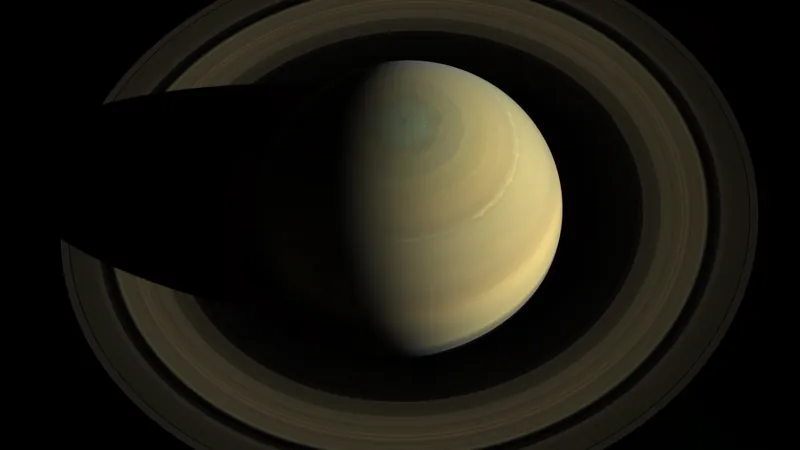
Your age on another world is your age in Earth years multiplied by the length of an Earth year and divided by the length of that world’s year. On Saturn, whose year NASA gives as about 29.4 Earth years, a ten-year-old would not yet be one. [NASA]
Why not just the planet pages? NASA’s planet pages and its fact sheet give slightly different year lengths for the outer planets, for example 30,687 and 30,589 days for Uranus. [NASA] [NASA Planetary Fact Sheet] The explorer uses the fact sheet for every world so they can be compared fairly. For the stories behind the numbers, see seasons on other planets.
Enjoyed a desk of official tilts, unblended figures, and a few seasonal stills?
No pop-ups. No intrusive advertising. Just interesting stuff. A little support helps the next climates.im site get built.